
If you’ve owned your home in the East Bay for fifteen, twenty, or thirty years, you’ve watched the neighborhood change — and your equity climb. Now the kids are gone, the yard feels like a lot of yard, and a question keeps surfacing: what is my home actually worth today?
It’s the right question to ask first. For most downsizers in Barrington, Bristol, and Warren, the home is the single largest asset in the move, and its value sets the budget for whatever comes next. This guide walks through how East Bay homes are valued in 2026, what moves the number up or down, and how to get a precise figure for your specific address.
The three numbers people confuse
Before you can answer “what’s my home worth,” it helps to separate three figures that often get mixed up:
Assessed value — the town’s figure for tax purposes. In Barrington, Bristol, and Warren this is frequently below true market value and updates on a revaluation cycle, not in real time. Don’t price off it.
Automated estimate (Zestimate, etc.) — a national algorithm’s guess. Useful as a ballpark, but it can’t see your renovated kitchen, your water views, or the quiet street that buyers pay a premium for.
Market value — what a ready, willing buyer will actually pay today. This is the only number that matters when you sell, and it comes from a local comparative market analysis (CMA).
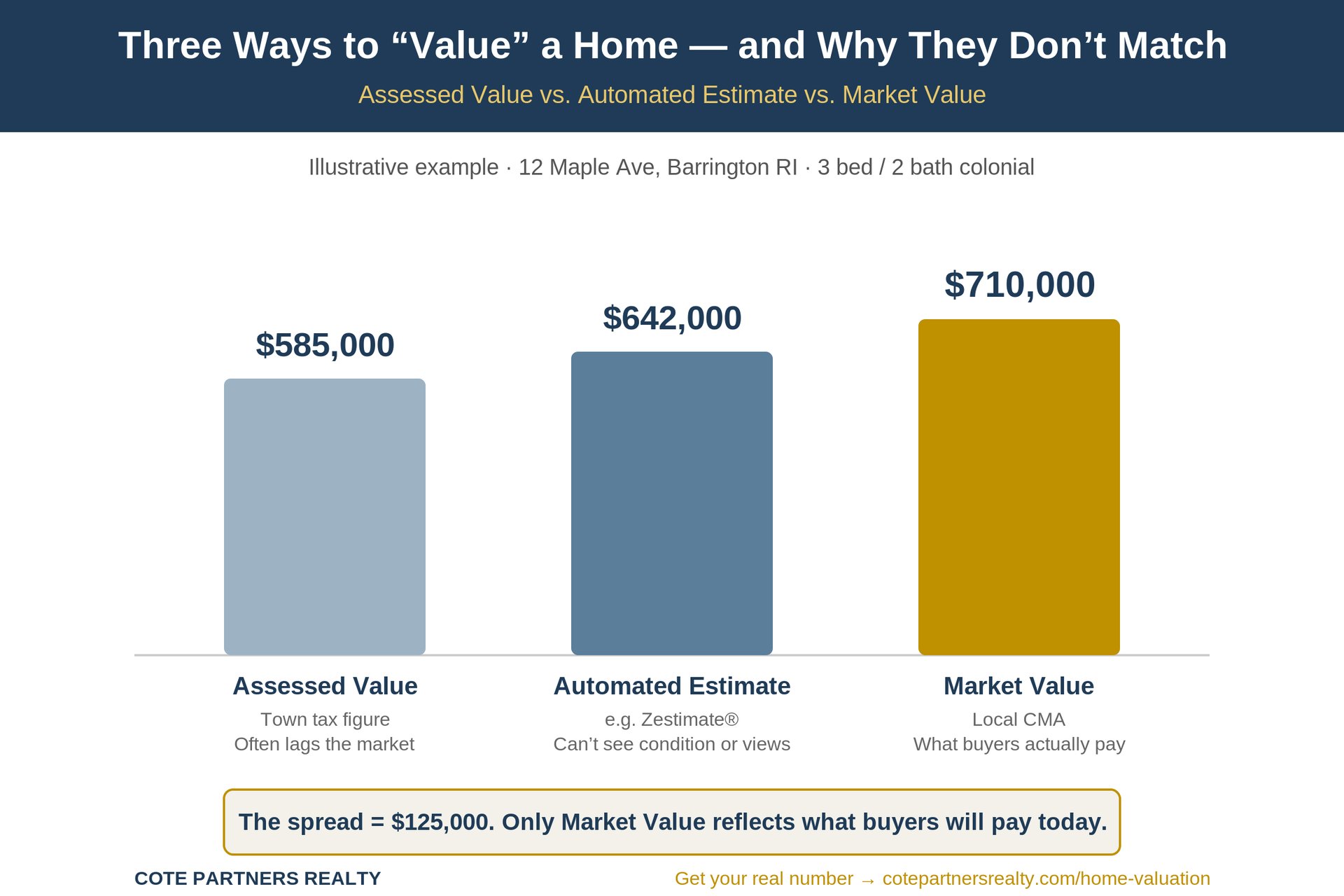
(Bar chart comparing assessed value, Zestimate, and market value for a Barrington RI home)
What drives East Bay home values in 2026
Every town in the East Bay has its own pricing logic. A few factors carry outsized weight for downsizers here:
Location and water proximity
Proximity to the water — Narragansett Bay, the Warren and Barrington rivers, the East Bay Bike Path — remains the single biggest premium driver. Even a partial view or a short walk to the shore can move value meaningfully. In Barrington, the school-district reputation adds another layer of demand.
Condition vs. updates
Long-held homes often have terrific bones but dated systems. Buyers in 2026 pay up for move-in-ready kitchens, baths, roofs, and mechanicals — and discount heavily for deferred maintenance they’ll have to tackle themselves. The gap between “lovingly lived in” and “updated” is often where tens of thousands of dollars live.
Lot, layout, and the downsizer paradox
Here’s a quirk worth knowing: the large family home you’re leaving is in high demand from the move-up buyers behind you, while the single-level or low-maintenance home you want is also in short supply. That tension can work in your favor on the sale — and against you on the purchase — which is exactly why timing and sequencing matter.
How a local CMA actually works
A comparative market analysis prices your home the way an experienced buyer’s agent and appraiser will see it. We look at:
Recent sales (typically the last 3–6 months) of comparable homes in your micro-market — not the whole town, but your stretch of it.
Active and pending listings — your real-time competition.
Adjustments for square footage, bed/bath count, lot size, water access, condition, and updates.
Absorption rate — how fast homes in your price band are selling, which signals whether you can push price or should price to move.
The result is a defensible range, not a single optimistic number. Pricing inside that range is what generates competing offers; pricing above it is the most common reason good homes sit.
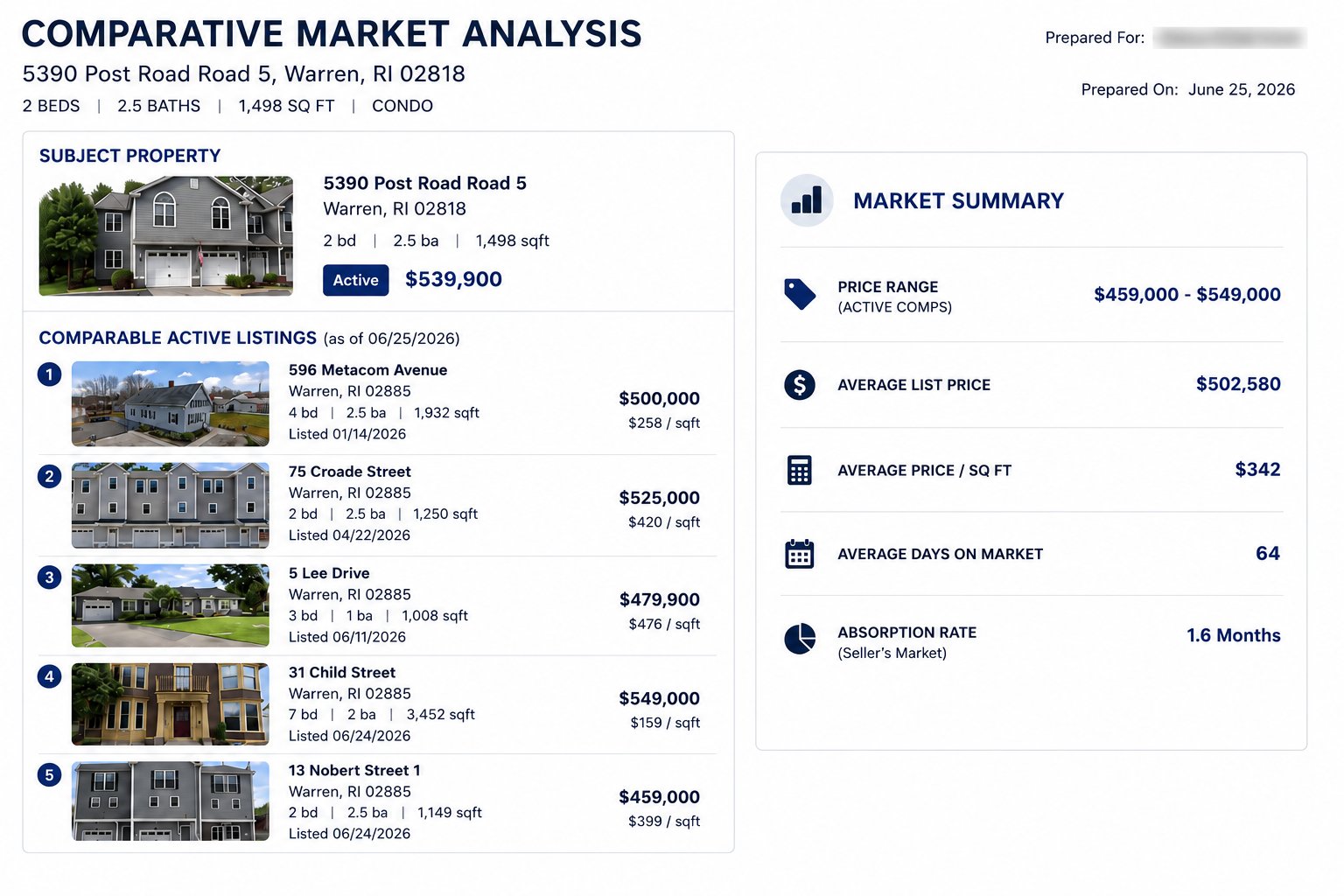
(Comparative market analysis showing recent comparable home sales in Warren RI)
Common pricing mistakes downsizers make
Anchoring to a neighbor’s list price — list prices are asking, not selling. Sold data tells the truth.
Pricing for the renovation you did in 2009 — updates depreciate; buyers price today’s condition.
Overvaluing emotional attachment — the memories are priceless to you and invisible to the market.
Underpricing out of caution — in a low-inventory East Bay market, leaving money on the table is just as costly as overpricing.
What your East Bay home might be worth right now
As of 2026, the median sale price across the East Bay is approximately [median sale price], with Barrington typically commanding a premium and Warren offering relatively more value per square foot. But medians hide your home’s specifics — a waterfront colonial and a 1,100-square-foot ranch a mile apart can differ by [X]%.
That’s why the only number worth acting on is one calculated for your address. We track every sale in Bristol, Warren, and Barrington, and our recent transactions show what local homes are actually closing for.
Your next step What your East Bay home might be worth right now
Knowing your home’s value is the foundation of a confident downsize. Once you have a real number, the next questions become answerable: Is 2026 the right time to sell? And what should you do — or skip — before you list? We cover both in the rest of this series:
Part 2: Should Empty Nesters Sell in 2026? The East Bay Market Read
Part 3: 8 Pre-Sale Moves That Maximize Your Equity
When you’re ready for a precise figure, request your free home valuation. We’ll handle it with local expertise and zero pressure.