
The first bills under Rhode Island's new Non-Owner Occupied Property Tax went out on July 16. The first installment was due September 15, and the second is due December 15. This is the tax that headlines call the "Taylor Swift tax." For owners of $1 million-plus homes that aren't a primary residence, it's now a real line item, not a proposal.
We covered the basics for out-of-state buyers in July (Buying From Away in 2026). This post is the follow-up, now that bills are in mailboxes and the tax is showing up at closings. It covers what the bill means, how to get out of it if it shouldn't apply to you, and what changes if you sell or buy a $1M+ home this fall.
The short version
- Who pays: owners of residential property assessed over $1,000,000 that they don't live in at least 183 days a year and don't rent at least 183 days a year.
- How much: $2.50 for every $500 of assessed value over $1 million. A home assessed at $2 million owes $5,000 a year, on top of the local property tax bill.
- How many: As of May, the state counted 22,431 homes assessed over $1 million. It flagged 8,245 of them as possibly non-owner occupied.
- Selling one? Every sale of a residential property assessed over $1M now needs a Certificate of No Tax Due from the state before closing, even if you don't owe anything. Start the request when you sign the P&S.
How your bill is calculated
The tax runs on your town's assessed value, not your purchase price or today's market value. For the current tax year (July 1, 2026 to June 30, 2027), the state uses each town's assessment as of December 31, 2024. Your use of the home is judged over the prior 12 months, July 1, 2025 to June 30, 2026.
Assessed value | Annual tax | Each quarterly installment |
|---|---|---|
$1,200,000 | $1,000 | $250 |
$1,500,000 | $2,500 | $625 |
$2,000,000 | $5,000 | $1,250 |
$3,000,000 | $10,000 | $2,500 |
$5,000,000 | $20,000 | $5,000 |
Formula: (assessed value − $1,000,000) ÷ $500 × $2.50. Installments are due Sept. 15, Dec. 15, Mar. 15 and June 15. Starting with the tax year that begins July 1, 2027, the $1 million threshold adjusts each year for inflation (CPI-U).
What it adds to a coastal tax bill, town by town
The surcharge is a flat statewide rate, so it hits hardest where local tax rates are lowest. That includes several of the coastal towns where second homes are concentrated. Here's what it adds to the local bill on a home assessed at $2 million:
Town | Local residential rate (per $1,000) | Local tax at $2M | State surcharge | Increase |
|---|---|---|---|---|
Little Compton | $4.79 | $9,580 | $5,000 | +52% |
Jamestown | $5.64 | $11,280 | $5,000 | +44% |
New Shoreham (Block Island) | $5.76 | $11,520 | $5,000 | +43% |
Narragansett | $6.79 | $13,580 | $5,000 | +37% |
Westerly | $7.11 | $14,220 | $5,000 | +35% |
Newport | $8.69 | $17,380 | $5,000 | +29% |
Middletown | $9.06 | $18,120 | $5,000 | +28% |
Bristol | $10.61 | $21,220 | $5,000 | +24% |
Portsmouth | $13.28 | $26,560 | $5,000 | +19% |
Barrington | $15.34 | $30,680 | $5,000 | +16% |
Local rates: RI Division of Municipal Finance, FY2026 residential real estate rates (12/31/2024 assessment date). These are illustrations. Your actual local bill depends on your assessment and any exemptions your town applies.
On a Little Compton or Jamestown second home, the state surcharge can add close to half again to the property tax. In Barrington, the same $5,000 is a much smaller share of a bill that was already high.
Got a bill you don't think you owe?
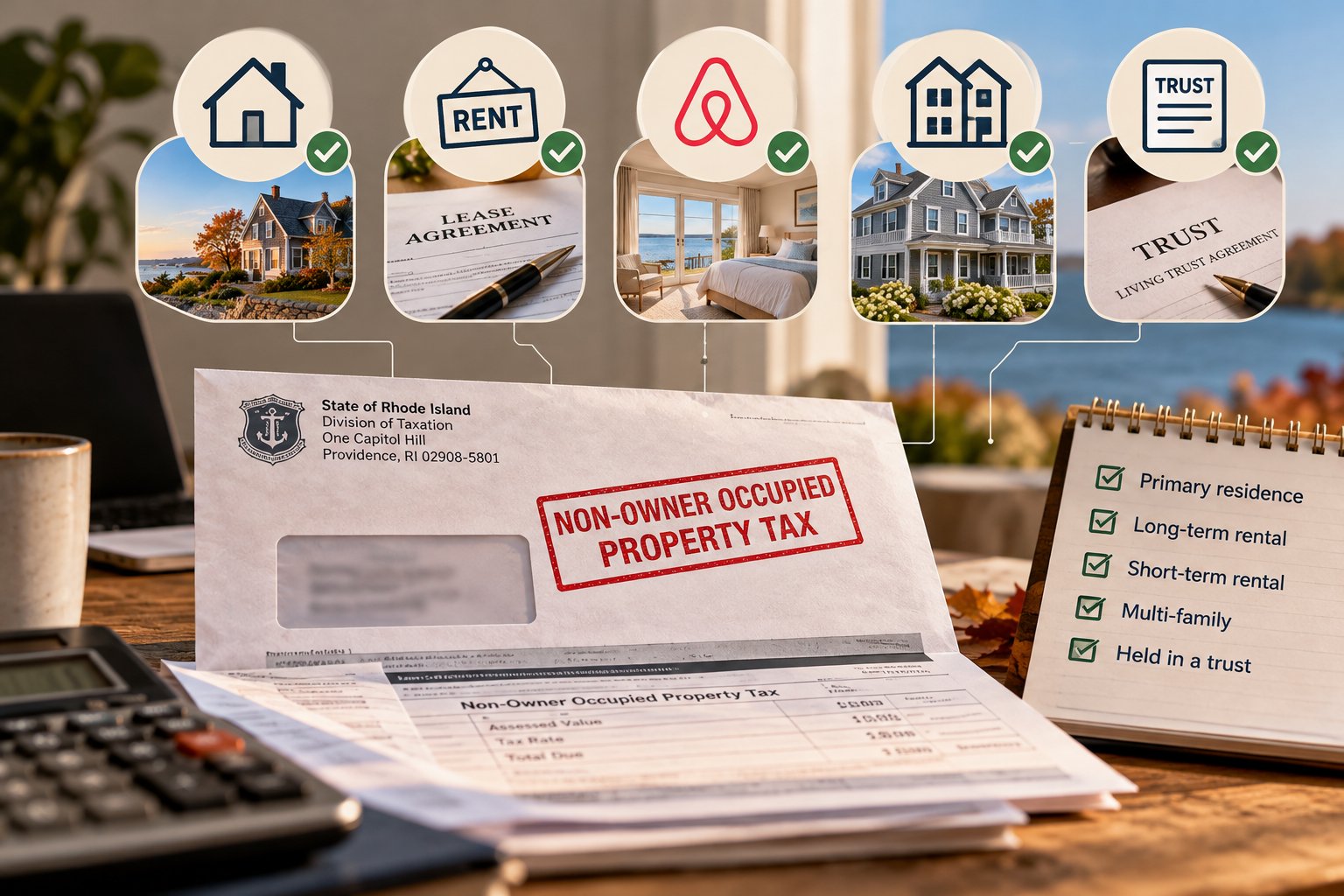
The state built its list from town assessment records and income tax filings. When it couldn't confirm a primary residence, it sent a notice. Some of those notices are wrong. You're likely exempt if one of these applies:
- It's your primary residence. You lived there at least 183 days in the prior July-to-June year. The days don't need to be consecutive. The usual proof is a Rhode Island resident income tax return (Form RI-1040) and a driver's license at that address.
- It was rented long-term for 183+ days under a written lease covered by Rhode Island's Residential Landlord and Tenant Act.
- It was a short-term rental booked 183+ days and you collected and paid Rhode Island sales and hotel tax on those stays.
- It's a multi-family with one owner-occupied unit, or with at least one unit that qualifies for an exemption.
- It's held in a trust, and the person living there is authorized by the trust and can document residency.
Two details trip people up. First, long-term and short-term rental days don't combine: 60 lease days plus 120 Airbnb nights doesn't reach 183. Second, one of the most common mismatches the state reports is the address itself. "W. Main" vs. "West Main," or a tax return filed to a P.O. box or your accountant's office, can flag a home that really is your primary residence. Questions go to the Division of Taxation at [email protected] or (401) 574-8955.
If you think your assessment itself is too high, you can still appeal it with your town. You pay the state tax at the current assessment and file a refund claim with the payment. The state adjusts once the appeal is resolved.
Selling a $1M+ home this fall: plan for two things
1. The Certificate of No Tax Due. Since July 1, every sale of a residential property assessed over $1 million needs one, including primary residences that owe nothing. The seller requests it with:
- Form RI-6678 (Non-Owner Occupied Property Tax Certificate Request)
- A copy of the signed Purchase and Sale Agreement
- Form RI-2848 (Power of Attorney), if your attorney or agent is filing for you. All owners must sign.
Email everything to [email protected] with the subject line "Certificate of No Tax Due – NOOPT." Submit at least 10 business days before closing. The certificate is good for 30 days. The state reports turning many of them around the same day, but about half of stalled requests are held up by power-of-attorney paperwork. Get the RI-2848 right the first time.
2. Who pays this year's tax. If you sell a taxable property this fall, the state's guidance puts the full 2026–27 tax on the seller, and it has to be paid before closing. Build that into your net sheet now. On a $2 million assessment, that's $5,000 off your proceeds that wasn't there last year.
Buying a $1M+ second home
- Underwrite to the assessed value, not the price. A home you buy for $950,000 can still be taxed if the town assesses it over $1 million.
- Decide how you'll use the home before you buy. Living there 183+ days, leasing it 183+ days, or running a registered short-term rental 183+ days each changes the bill. Each comes with its own paperwork.
- Know when it starts. For a purchase that closes this fall, the state's guidance puts the buyer on the hook beginning with the tax year that starts July 1, 2027. That depends on how you use the home between now and then.
- Watch revaluations. Towns revalue on a rolling schedule. A home assessed at $940,000 today can cross $1 million at the next revaluation, so check where your town is in its cycle.
Our checklist for $1M+ sales
- Pull the town assessment and confirm occupancy or rental history at listing intake.
- Put the surcharge on the seller's net sheet if the home is taxable.
- Line up the RI-2848 early, and file the RI-6678 the day the P&S is signed.
- Confirm with the closing attorney that the certificate is in hand 10 business days out.
Closing attorneys and cooperating brokers are already asking for the certificate. A missing one is now one more thing that can push a closing date.

Want to see what this means for your property? We can pull your assessment, estimate your surcharge, and show what it does to your net if you sell, or to your carrying cost if you buy. We can also run a current market value for your home. No pressure, just the numbers.
Cote Partners Realty
343 Main Street, Warren, RI
Office (401) 307-3768 · Cell (617) 320-9584
[email protected] · ownri.com
Local Expertise. Lasting Results.
Sources: RI Division of Taxation, Non-Owner Occupied Property Tax page (updated Aug. 6, 2026), FAQ, Advisory 2026-16 "Bills Mailed" (July 16, 2026), Advisory 2026-17 "Certificate of No Tax Due" (July 31, 2026), and Title Insurance presentation (Aug. 7, 2026); R.I. Gen. Laws ch. 44-72; RI Division of Municipal Finance, FY2026 Tax Rates by Class (12/31/2024 assessment date); Rhode Island Association of REALTORS®, "New Non-Owner-Occupied Property Tax and Multi-Unit Residential Properties" (July 29, 2026); WPRI, "'Taylor Swift tax' goes into effect in Rhode Island" (July 1, 2026). This is general information, not tax or legal advice. Confirm your situation with the Division of Taxation, a CPA or a Rhode Island real estate attorney. Information is believed reliable but is not guaranteed. © 2026 Cote Partners Realty, LLC. Licensed in Rhode Island. Equal Housing Opportunity.